... ok, maybe Call-ads do....
And Why Your Shop Link is Killing Your B2B Leads
It happens almost every week. I sit down for a consultation, and a business owner looks me in the eye with a mix of hope and frustration to say:
"Dirk, can you help us rewrite our Google Ads? Our conversion rate is terrible."
I usually take a sip of coffee before dropping the uncomfortable truth: "Your ads are fine. Your website is the problem."
This is the most common misunderstanding in the world of PPC. We tend to blame the vehicle (the Ad) when the destination (the Landing Page) is a building site.
To fix your funnel, you must understand the distinct Job Description of each element:
- The Job of the Ad: To deliver Qualified Traffic. It ensures that the person clicking is searching for exactly what you offer.
- The Job of the Landing Page: To convince that traffic to take the Conversion Action.
If the ad does its job but the user doesn't convert, tweaking the headline won't help. You have a Landing Page Experience problem.
The "Warehouse" Mistake: A Case Study in Intent Mismatch
I had a review session just this week that perfectly illustrates this.
I was auditing a B2B client who specialises in equipping large-scale warehouses with complex, heavy-duty shelving solutions. These are six-figure projects requiring engineering and safety planning.
1. The Ad: I looked at their Search Terms Report. The traffic was pristine. They were paying for terms like "industrial pallet racking installation", "warehouse storage systems", and "cantilever shelves". These were serious, industrial buyers. The ad was doing its job perfectly. The CTR confirmed that view.
2. The Landing Page: Their conversion rate was near zero. Why? When I clicked the ad, I didn't land on a page offering a consultation or a project quote. I landed on a page describing their shelving solutions with a big button pointing to their Online Shop. Essentially, I was taken to a generic e-commerce grid showing shelf models with four-digit price tags.
The Diagnosis
- The User's Intent: They wanted a project solution (Consulting/Service).
- The Landing Page's Offer: It was trying to sell a commodity (Product/Transaction).
Think about that for a moment. This Google Search traffic was cold traffic from industrial buyers. They likely don’t know the seller yet. They have specific requirements and need a tailored solution.
They need to talk to a human first. What they won’t do is pull out a company credit card and place a five-figure order with a vendor they have never dealt with.
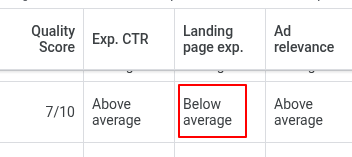
Google’s algorithm had already spotted this. In the Keyword Quality Score report, the Landing Page Experience metric was flashing "Below Average" for the main keyword with the highest amount of clicks and impressions.
The bounce rate in GA4 was sky-high probably because sophisticated B2B buyers don't want to "Add to Cart" a €50,000 warehouse installation; they want to talk to an engineer.
The 7 Levels of Conversion: Where Did It Break?
When we talk about the "7 Levels of Conversion" —the psychological steps a user goes through from click to sale— this client failed at the very first hurdle: Relevance.
Creating a high-converting journey isn't just about pretty colours; it's about removing friction at every level. Let’s review the first two hurdles of the model for this particular project:
1. Relevance (The First Level) Does the page match the promise of the ad? In our warehouse example, the ad promised a solution ("We equip warehouses"), but the page delivered a hardware store catalogue. The relevance score plummeted.
2. Trust For B2B services, the landing page must do the heavy lifting of building authority instantly. A generic shop page looks like a commodity seller. A proper landing page would feature case studies, "Trust Signals" like client logos, and engineering certifications.
The Solution: Align the Searcher's Intent
If you are selling a complex B2B service, your landing page must guide the user towards a conversation, not a checkout.
For my warehouse client, the fix wasn't changing the ad copy. It was changing the destination. The plan now is to send the traffic to a dedicated landing page that:
- Acknowledges the Pain Point: "Running out of warehouse space?"
- Offers Authority: Shows photos of massive, completed installations.
- Matches the Intent: Replaces "Shop Now" with "Request a Site Survey."
Conclusion
Stop asking your Google Ads to do the Landing Page's job.
If your Search Terms are relevant but your phone isn't ringing, stop tweaking your bid strategy. Look at where you are sending people. Put yourself in the shoes of your audience!
If you invite guests to a dinner party (the Ad) but send them to the garage (the Landing Page), don't be surprised when they turn around and leave.