Last week, I completed an audit for a pharmaceutical campaign targeting a very specific medical niche for a rare disease treatment. The client was understandably frustrated. They had a budget, they had a message, and they believed they were reaching patients and medical professionals at the exact moment they were searching for solutions on Google.
When I opened the account to review the last 180 days of activity, the data told a story that was both surprising and entirely too common in the world of unmanaged Google Ads.
The Hundred Percent Mismatch
The campaign was technically set up as a Search campaign. The intention was clear: capture high-intent traffic from people typing specific terms into the Google search bar. However, the reality was a total vanishing act. Within that six month period, the campaign recorded zero impressions on Google Search.
Every single impression and click had occurred on the Google Display Network!
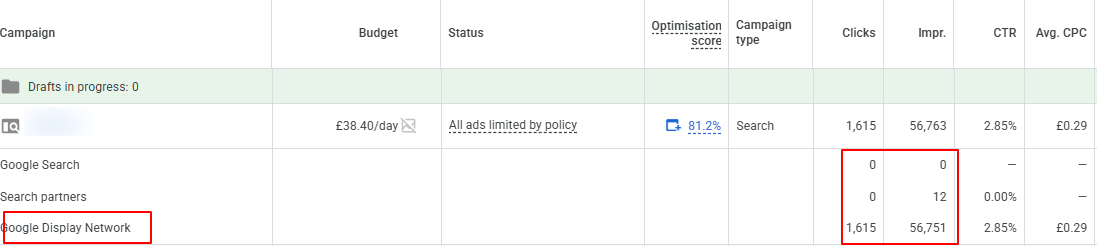
This is what I call a network mismatch. While the settings allowed for Search, the algorithm had diverted the entire budget to websites, blogs, and apps across the internet. Instead of appearing for a patient searching for nitisinone tablets or AKU treatment, the ads were being shown to a broad audience in environments where intent is notoriously low.
Why Algorithms Choose the Path of Least Resistance
You might wonder how a Search campaign fails to show up on Search even once. The answer lies in the relationship between ad quality and the bidding environment. In this case, the ads were rated as poor strength. They lacked sufficient headlines and failed to incorporate the target keywords into the copy.
Because the ads were not competitive enough to win auctions in the highly specific and expensive Google Search environment, the algorithm looked for a way to fulfill its mandate: spending the daily budget.
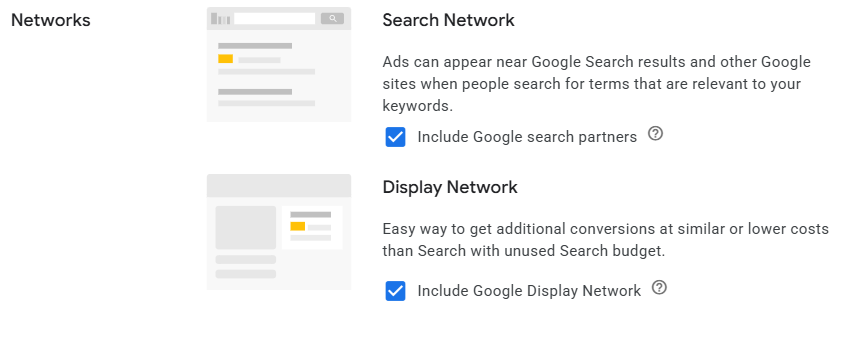
By having the Display Network and Search Partners options checked, the advertiser essentially gave Google permission to spend that money elsewhere. The AI took the path of least resistance, buying up cheap, low-intent impressions on the Display Network just to keep the gears turning.
Tracking the Wrong Signals
The confusion was deepened by the fact that the dashboard showed conversions. On paper, it looked like the campaign was working. But as a precision gardener of lead generation, I always look at the nature of those conversions.
The campaign was tracking simple page loads, specifically the patient enrollment page. If a user landed on the page, Google counted it as a success. This created a dangerous feedback loop. The algorithm was being trained on low-value data. It didn’t matter if the person filled out a form, downloaded a treatment guide, or clicked the phone number; the mere act of a page loading was enough to signal the AI to find more of that same audience.
In a niche as small as the treatment of this rare disease, which sees only about 210 searches per month in the United States, this lack of precision is catastrophic. You cannot afford to fill a tiny bucket with junk traffic.
Strategic Recommendations for a Fresh Start
Because the current campaign was fundamentally misaligned, my primary recommendation was to disable the existing setup entirely and start fresh with a strategy built on precision rather than volume.
First, the technical guardrails must be tightened. This means immediately disabling the Display and Search Partner networks to ensure every penny is spent on the intended platform. The bidding strategy should revert to Maximize Clicks until the account has gathered enough genuine, high-quality conversion data to eventually support automation.
Second, we must move away from broad match, one-word single word keywords. In a rare disease niche, these terms attract too much informational traffic from people simply looking for a definition. Instead, I recommended using Exact Match keywords in brackets to target specific intent, such as [disease] treatment or [drug] tablets.
Third, the conversion tracking needs to be rebuilt to measure active signals. We should only count a conversion when a user takes a meaningful action, such as a PDF download or a click on a contact link.
Finally, the landing page itself must be optimised to mirror the search intent, ensuring that the headline and title tags explicitly address the user’s search for treatment.
Precision is the only way to win in a niche market. Without it, you aren’t running a campaign; you are just financing the algorithm’s mistakes.
Book a consulting session with me on Fiverr or send me a message here on LinkedIn.