An algorithm is a mathematician, not a business strategist. In its quest for efficiency, it will always follow the path of least resistance—even if that path leads your core business into a desert.
It was the first week of January 2026, a critical booking period for the travel industry. I received an email from Thomas, the owner of a German travel agency specializing in language courses abroad.
The subject line seemed positive enough. He wished me a happy new year and told me that the Google Ads campaigns were running very well. The cost per lead was down, and the total number of inquiries was up. On paper, it looked like a perfect win.
But as I read further, a worrying detail emerged.
Thomas explained that historically, 60% of his revenue during this season comes from teenage students looking for summer language camps. The remaining 40% comes from working adults and the "50-plus" demographic.
However, the leads generating this "perfect" performance in our Google Ads account told a different story. We were seeing 60% adults, a healthy chunk of seniors, and almost no students.
The campaigns were successful, but they were bringing in the wrong customers. The core business—the student segment—was starving.
The Trap of the Path of Least Resistance
To understand what went wrong, we have to look at how we structured the account. We had set up campaigns based on destinations: Malta, Ireland, and England. Within those campaigns, we created separate ad groups for the different audiences: "Teenage Students," "Business Adults," and "Seniors."
We were using a "Maximise Conversions" bidding strategy. This is where the machine learning takes over, and this is exactly where the problem lay.
The algorithm is a mathematician, not a business strategist. It looked at the data and realised that the "Adult" and "Senior" segments were converting slightly easier and perhaps at a lower cost than the parents of teenagers.
In its quest for efficiency, the algorithm did exactly what it was programmed to do: it shifted the budget toward the path of least resistance. It starved the "Teenage Student" ad groups of impressions to feed the "Adult" ad groups, simply because the metrics looked better on a spreadsheet.
The machine was optimizing for the metric, but it was neglecting the business model.
The Strategic Pivot
We needed to force the system to respect the business priorities. You cannot simply ask an algorithm to "try harder" on a difficult segment if a cheaper option exists within the same budget pool.
The solution was a structural separation.
I removed the "Student" ad groups from the destination campaigns and built a dedicated "Student Language Travel" campaign. Crucially, I gave this campaign its own ring-fenced budget. The campaign is now structured by destinations and not audiences, anymore.
By isolating the student segment, we removed the competition. The algorithm could no longer steal budget from the teenagers to pay for the seniors. It was forced to go out and find the parents searching for language trips, regardless of whether they were slightly more expensive to acquire than a 50-plus traveler.
Expert Insight: The Ring-Fencing Rule
"You cannot ask an algorithm to 'try harder' on a difficult segment if a cheaper, easier option exists in the same pool. To the machine, a senior traveler and a student parent are just data points. To the business owner, they are the difference between a season that thrives and one that dies." — Dirk Röttges
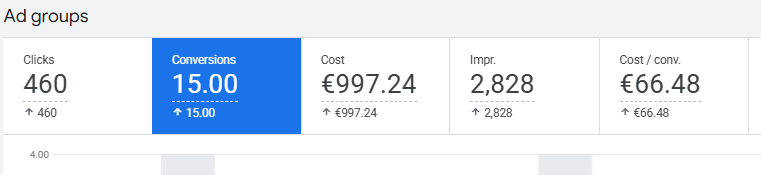
The Result after just 14 days
We launched the new structure immediately. After weeks of silence from the student sector, we generated 15 highly qualified student inquiries in just two weeks. We achieved this across England, Ireland, and Malta, with a cost per conversion of €66.48 which is acceptable for the client.
The algorithm is a magnificent servant but a terrible master.
Lessons learnt: If you bundle different audiences with different conversion behaviors into a single budget, the machine will always favour the easiest win. Sometimes, you have to step in, separate the budgets, and pay for the customers your business actually needs, not just the ones Google finds easiest to get.
Conclusion
If your campaigns are showing green arrows but your sales team is complaining about the lead mix, check your structures. Are your core products being cannibalised by your secondary offers?
I specialise in diagnosing these structural flaws that keep businesses from reaching their full potential. If you suspect your account is optimizing for the wrong metrics, let’s take a look under the bonnet.