The Bangkok Coincidence and the Social Media Trap
It is a strange coincidence in my line of work that specific architectural flaws tend to cluster together. Earlier this week, I was unpicking a tangled Google Ads account for an online therapy clinic in Bangkok. Barely forty-eight hours later, I found myself sitting in Potsdam, staring at a similar structural disaster in the account of a solo online psychologist based here in Germany.
The client is a highly qualified systemic therapist who has run a successful online practice for private payers for over five years. Historically, she acquired the vast majority of her patients through Google. However, after restructuring her specific service offerings last year, she hired a “certified expert” to redesign her campaigns.
Six months later, her stream of new inquiries from Google had completely dried up. She was surviving solely on referrals.
Like many solo traders, she operates on a strict, limited budget. She had allocated just 8 € a day to acquire new clients. When I opened her account to perform the audit, the dashboard was a sea of green. The click-through rate was nearing 10 percent, and she was buying clicks for mere pennies.
Yet, her phone was not ringing. She was trapped in the Performance Paradox: her metrics looked flawless to the machine, but her business growth was zero.
The Illusion of Demographics in Search
The root cause of her budget waste was a fundamental misunderstanding of how Google Search operates by the so called “Certified Google Ads specialist”. The previous agency had applied a Social Media Logic to a Search environment.
In her account, I found ad groups bizarrely divided by target personas. There was an ad group specifically named for stage professionals and actors, and another dedicated to CEOs and managers.
On platforms like LinkedIn or Facebook, targeting a demographic or job title makes perfect sense. In Google Search, it is a recipe for disaster. Users do not type their job titles into a search bar when they are suffering from a personal crisis or burnout. They search for their symptoms and their problem.
Because there is virtually zero search volume in Germany for terms like “psychologist for politicians” or “therapy for stage actors“, the algorithm began desperately looking for any vaguely related search terms just to spend her daily budget. This triggered a cascade of irrelevant impressions.
The Danger of the Global Megaphone
To compound the demographic error, I uncovered a critical geographical failure. The campaign targeting was set to “All countries and territories“. For a German-speaking solo therapist with a microscopic daily budget, this was financial sabotage.
Furthermore, the bidding strategy was set to Maximize Clicks. When you instruct Google to get you the most clicks possible for 8 Euros, and you remove all geographic restrictions, the machine will ruthlessly find the path of least resistance. It will bypass high-intent, expensive searches and buy the cheapest, lowest-quality traffic available globally.
The audit revealed an Impression Share of under 10 percent and a Rank Loss of 85 percent. She was not paying for individuals seeking a therapist. She was paying for university students researching psychology definitions, people in Austria looking for local in-person appointments, and individuals searching for free, state-funded therapy.
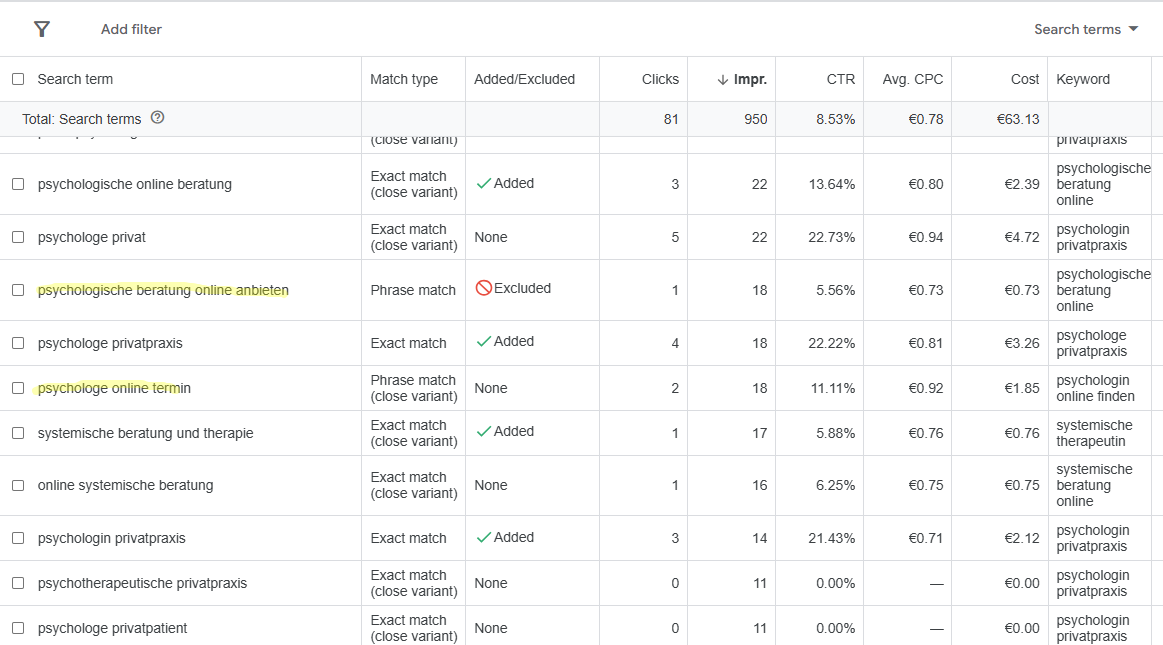
She was effectively standing in a global stadium with a megaphone, shouting her message to people who did not speak her language or understand her offer, while the few people in her actual neighbourhood who needed her help were drowned out.
The Congruence Failure
Even when a relevant search did slip through the cracks, the user journey was broken. I noticed that if a user searched for online burnout coaching, they clicked an ad and landed on a generic homepage that talked extensively about family therapy and career mastery.
The attention span of a user in distress is incredibly short. If the specific promise made in the search ad is not immediately validated in the first headline of the landing page, the user bounces. There was zero congruence between the search intent and the destination.
Reclaiming Control: Precision Over Volume
When dealing with high-ticket services or premium private healthcare, you must earn the right to automate. You cannot trust the algorithm until you have proven you can attract the right human beings.
We immediately implemented a two-phase recovery plan. Phase one was the Quick Fix. We stripped away the bloated, demographic-based ad groups and paused all the fabricated keywords that lacked actual search volume.
We abandoned Broad Match entirely. We moved strictly to Exact Match keywords, such as [systemische beratung online]. If a user did not explicitly search for the exact service she provided, we refused to enter the auction. We also restricted the geographic targeting strictly to Germany.
Phase two is the Strategic Realignment. We mapped out a structure based on pure search intent rather than personas. This means separate, isolated campaigns for general online therapy, couples therapy, and burnout coaching, each directing traffic to a highly specific, dedicated landing page.
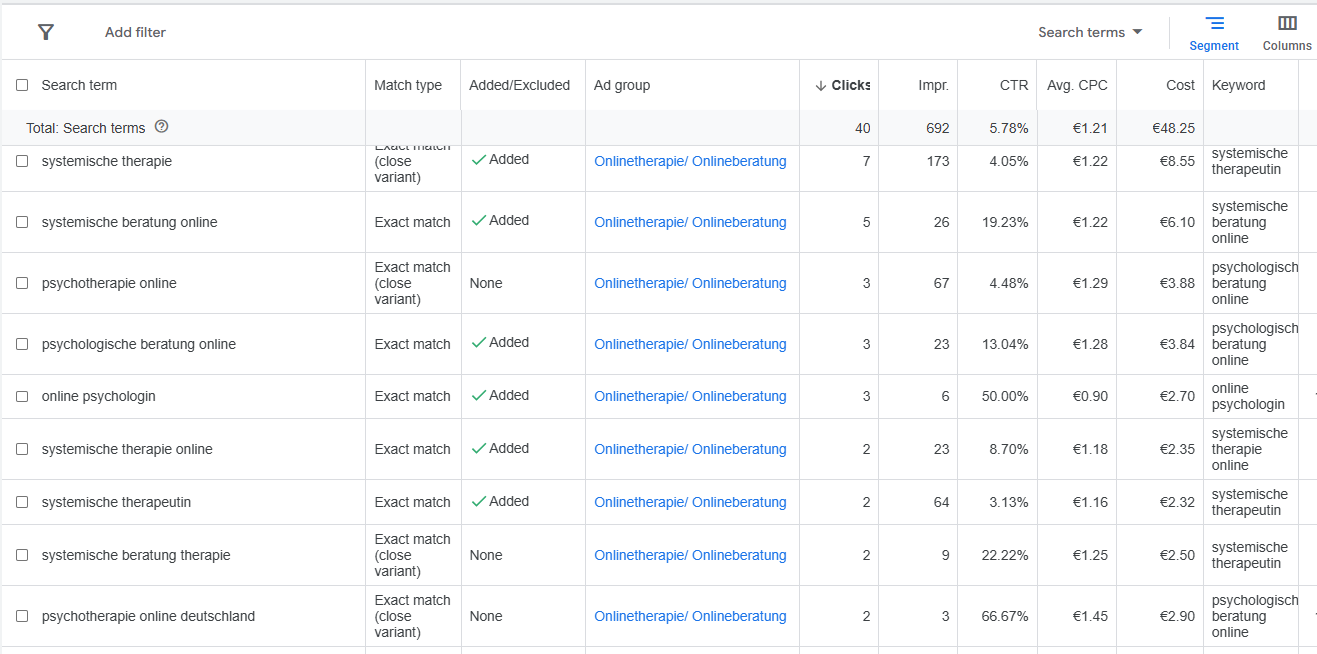
After just 1 Week of running the campaign with the new structure: The system recorded the first Conversion in 6 Months!

The Takeaway for Solo Traders
Shortly after implementing the Quick Fix, the client emailed me to ask if she should let the new Exact Match structure run for four weeks before making further tweaks. My answer was a resounding yes. You must let the dust settle and observe the new baseline of quality.
Traffic is a commodity you can buy effortlessly. Qualified leads are an asset you must earn through precision.
If you are a solo service provider with a limited budget, you cannot afford to feed the algorithm with irrelevant data. You must dictate the rules of engagement. Stop trying to cast the widest net possible with social media tactics, and start focusing on the few specific, high-intent searches that actually move the needle for your practice.
Book a consulting session with me on Fiverr or send me a message on LinkedIn.