It usually begins with a sense of triumph. A business owner opens their Google Ads dashboard and sees a surge in traffic: 3,000 clicks in a single month. For a niche B2B firm providing high-end architectural visualisation, these numbers suggest a market takeover.
But when I sat down to audit this particular account for a client in Berlin, the silence in their sales department told a different story. The clicks were there, but the leads were missing. This is the performance paradox in its purest form—where digital metrics are flourishing while business growth remains at zero.
The Allure of the Empty Metric
During my initial review, the culprit was immediately apparent: a Performance Max campaign that had run wild. In the last thirty days, this campaign had generated over 40,000 impressions. For a service as specific as B2B 3D visualisation for architects and developers, such volume is rarely plausible. A quick dive into the placement reports revealed the truth. The ads weren’t appearing in front of decision-makers at architectural firms; they were being served on mobile gaming apps and the Google Display Network to people looking for free IKEA room planners and home decoration ideas.
The business was paying for curiosity, not intent. Because the campaign was targeting the whole of Germany, Austria, and Switzerland without a narrow focus, the algorithm prioritised the path of least resistance: cheap, low-intent clicks from private consumers rather than professional contracts.
The Algorithm is Only as Smart as Your Data
We turned off the Performance Max campaign immediately and proceeded to review the search campaign. Unfortunately, the situation did not improve. The technical tragedy of this campaign lay in its bidding strategy. The campaign was set to maximise conversions with a target CPA of sixty-one Euros. This is what I call a recipe for disaster. To use algorithmic bidding effectively, the system requires a steady stream of high-quality data to learn from. This account had recorded exactly one conversion in a month—an undefined form submission of dubious quality.
When you ask an AI to find conversions based on a sample size of one, you are essentially asking it to fly a plane in a total blackout without instruments. The system, desperate to meet its target, began chasing the cheapest possible traffic. In the B2B sector, if you don’t provide the machine with enough signals of what a real lead looks like, it will default to finding the highest volume of clicks at the lowest cost. In this case, that meant furniture enthusiasts and students, not paying clients.
When Broad Match Becomes a Budget Leak
The search campaign was equally troubled. It contained over sixty keywords, all set to broad match. While Google often encourages this to improve its optimisation score, for a B2B firm, this is a vanity metric that hides a massive budget leak. The account was paying for search terms like “free 3D room creator” and “IKEA planner”.
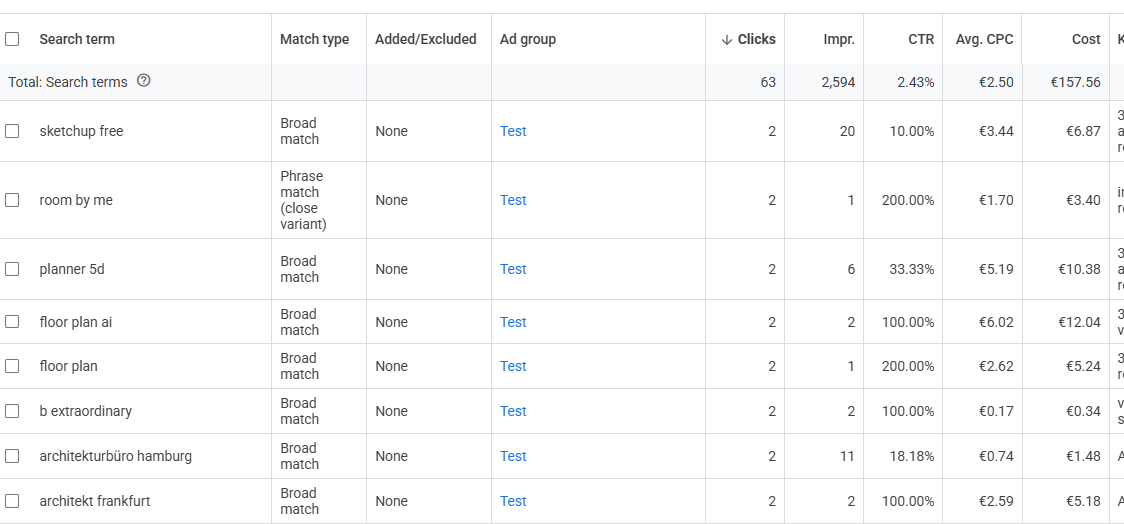
Furthermore, the ads were being shown for competitor brand names and irrelevant international queries from regions like Russia and the Middle East, which the firm doesn’t even serve. The click-through rate was a dismal 2.2 percent. In a high-intent B2B market, I expect to see a rate above 10 percent. A low rate tells Google your ad is irrelevant, which lowers your quality score and forces you to pay more for every single click.
Precision over Volume: The Path Forward
To save this account, we had to perform a digital intervention. The first step was to disable the Performance Max campaign. It simply isn’t the right tool for a niche B2B service with zero conversion data. We then turned our attention to the search campaign, ruthlessly pruning the keyword list from sixty generic terms down to fifteen high-intent phrases.
We shifted from broad match to exact match only. We want to ensure that if someone is looking for “Architekturvisualisierung,” they find our client—and not someone looking for a free mobile app. We also reverted the bidding strategy to maximise clicks. We need to manually verify that the traffic is of the highest quality before we ever trust the algorithm to take over again.
In the world of Google Search Ads, volume is often just vanity. True success is found in the precision of the lead, not the quantity of the click.
Book a consulting session with me on Fiverr or send me a message here on LinkedIn.