In financial services, people don't buy from forms; they buy from human beings. If your landing page looks like a masked stranger, you are financing your own failure.
Today I received an inquiry from an ambitious German insurance broker. He had a clear goal: he wanted to generate leads for disability insurance products, targeting specifically employees between the ages of 25 and 45.
He sent me the link to his landing page with a sense of pride. "Dirk," he said, "I have kept it completely clean. No distractions, just the offer and the form. It is streamlined for conversion."
I opened the link, and I stared at the screen for a long moment. Something like this:
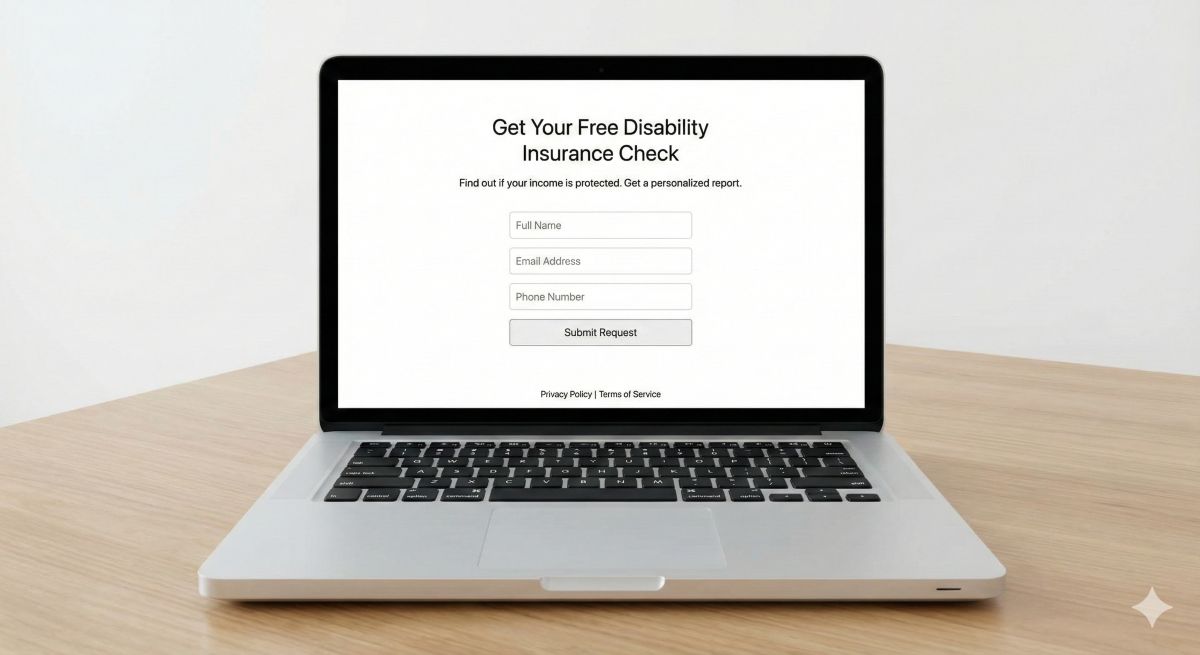
He was right about one thing. It was certainly clean. It had a headline offering a free check, a brief description of a 15-minute video consultation, and a data capture form. But as I looked at it, I did not feel the urge to sign up. I felt an instinctual urge to click the "Back" button immediately.
This broker had fallen into a classic trap. He believed that removing friction meant removing personality. In doing so, he had created what I call a "Naked Landing Page." It was a page stripped of the one currency that matters more than anything else in the financial services sector: Trust.
The "Stranger on the Street" Test
I asked the broker to imagine a scenario in the physical world.
Imagine you are walking down a busy high street. A man approaches you. He is wearing a plain grey suit and a mask that covers his face so you cannot see who he is. He holds a clipboard and blocks your path.
"Hello," the masked stranger says. "I would like to review your financial security. Please write down your full name, address and your private email address on this clipboard, and I will contact you later."
Would you give him your details?
Of course not. You would likely clutch your bag tighter and walk away as fast as possible.
This landing page is the digital equivalent of that masked stranger. It asks for sensitive personal data—a name, an email, and a phone number—but it offers absolutely no identity in return.
There is no company logo. There is no name of the broker. There is no photo of the human being behind the service. There are no credentials, no address, and no proof that this business even exists outside of this solitary HTML file.
The David vs. Goliath Reality in the Insurance Industry
The tragedy of this approach becomes clear when you look at the market he is trying to enter.
Disability insurance—or Berufsunfähigkeitsversicherung in German—is among the most competitive verticals in Google Ads. The Cost Per Click (CPC) for high-intent keywords in this sector can easily range between €10 and €20, sometimes even higher.
When this broker turns on his Google Ads campaign, he is entering an auction against giants. He is competing against massive insurance aggregators like Check24 or Verivox, and established titans like HUK-Coburg or AXA.
These competitors spend millions on video and TV advertising to build brand familiarity. When a user lands on their pages, they already feel a sense of safety. They see the familiar logo, the he thousands of customer reviews, and other trust elements.
If this broker pays €15 for a click, he has roughly three seconds to justify why a user should trust him over the giant they saw on TV last night. By presenting an anonymous, grey form, he is not just losing that battle; he is financing his own failure.
The Pivot: How a Small Broker Can Win
So, is it possible for a solo broker to even compete?
Absolutely! But the strategy must shift entirely. You cannot beat the giants on volume or brand recognition. You must beat them on intimacy and expertise.
Here is what I recommended him to reconstruct this landing page to make it convert:
First, we need to leverage the power of proximity. The big aggregators operate on a national level; they are faceless entities located in distant call centres. This broker has a distinct advantage: he is local. We need to narrow the campaign to his specific city or region and reflect this on the landing page. We don't just say "Insurance Expert"; we say "The Disability Insurance Expert in [City Name]." We add a map and a photo of his office building. This signals accessibility. It tells the client that this is a real person in their community who can be held accountable. You cannot walk into a comparison portal's office for a coffee and a chat, but you can walk into his. That level of physical security is a massive trust signal.
Second, we need a face. In professional services, people buy from people. A high-quality photo of the broker, smiling and looking professional, instantly removes the "stranger danger" anxiety. It signals that there is a real human being accountable for the advice being given.
Third, we need authority. We need to answer the question: "Why him?" This page needs a brief bio stating that he has been an expert for +10 years, or that he has successfully insured 500 clients. If he has certifications or awards, they need to be placed prominently on his landing page.
Fourth, we need social proof. A claim of expertise means nothing without evidence. We need to import Google Reviews or testimonials from real clients. Seeing that others have used this service and were satisfied is a powerful psychological trigger that grants the visitor permission to trust.
Finally, we need to reframe the offer. Instead of a generic "Check," we should leverage his specific focus. If he specializes in employees aged 25-45, the copy should speak directly to their specific fears and problems, perhaps referencing specific industry pitfalls that the big aggregators might miss.
Expert Insight: The Proximity Advantage
"You cannot beat the global insurance giants on volume, but you can beat them on intimacy. A comparison portal is a faceless call center; a local broker is a neighbor you can have coffee with. That accountability is your greatest conversion lever." — Dirk Röttges
Feature | The "Naked" Page (Masked Stranger) | The "High-Trust" Page (Dirk’s Way) |
|---|---|---|
Identity | Anonymous form, no logo. | Clear branding and broker headshot. |
Proof | "Free Check" claim only. | Verified Google Reviews and testimonials. |
Local Signal | Generic national reach. | Local map and physical office presence. |
Credibility | Zero bio or certifications. | 10+ years expertise and industry awards. |
Conclusion
Traffic is a commodity you can buy. Trust is an asset you must earn.
In the high-stakes world of B2B and financial services, your landing page has to do the heavy lifting of building authority instantly. If you ask for a user's data before you have proven your worthiness to hold it, your conversion rate will remain at zero, regardless of how much you optimize your ads.
Don't hide behind a clean design. Step out from behind the curtain. Show your face, highlight your local presence, and give your visitors a reason to believe in you.